
Autonomous Storage and Retrieval Warehouse Solutions
Autonomous Storage and Retrieval Warehouse Solutions transform how products, materials, pallets, and inventory are stored and moved within a warehouse. By combining automated equipment, intelligent software, and advanced algorithms, these systems can automatically locate, retrieve, transport, and store goods with minimal manual intervention.
Designed for flexible and scalable warehouse operations, autonomous storage and retrieval systems help businesses make better use of available space while reducing repetitive labor and improving inventory accuracy. Instead of relying on employees to manually travel through warehouse aisles to find and move inventory, autonomous robots can perform these tasks efficiently and consistently.

How Autonomous Storage and Retrieval Robots Work
Autonomous warehouse robots are designed to move inventory between storage locations and designated pickup or drop-off points. The system's software coordinates robot movement, inventory locations, storage capacity, and retrieval requests to help keep products flowing through the warehouse.
Depending on the warehouse configuration and application, autonomous robots can:
- Retrieve pallets, containers, totes, or other stored goods
- Transport inventory between storage and work areas
- Automatically place products into available storage locations
- Deliver inventory to picking, packing, production, or shipping areas
- Navigate warehouse environments with minimal human intervention
- Optimize storage locations based on inventory and workflow requirements
- Coordinate multiple robots operating within the same warehouse
- Reduce unnecessary travel throughout the facility
- Improve inventory accessibility and organization
- Support high-density storage configurations
Maximize Warehouse Storage Capacity
Traditional warehouse layouts often require substantial aisle space for forklifts and other material-handling equipment. Autonomous storage and retrieval systems can allow businesses to use vertical and horizontal space more efficiently, potentially increasing storage capacity without expanding the building footprint.
By intelligently positioning inventory and automating retrieval, these systems help warehouses get more value from the space they already have.
Reduce Manual Labor and Repetitive Tasks
Warehouse employees can spend significant amounts of time walking, driving, searching for inventory, and transporting materials. Autonomous robots take over many of these repetitive material-handling tasks, allowing employees to focus on higher-value activities such as order fulfillment, quality control, production, and warehouse management.
The result is a warehouse operation that can move inventory with less manual handling while maintaining consistent workflows throughout the day.
Improve Inventory Movement and Accuracy
Autonomous storage and retrieval systems use warehouse software to coordinate where inventory is stored and where it needs to go. Automated movement reduces opportunities for products to be misplaced, overlooked, or transported to the wrong location.
Real-time system coordination can help businesses maintain organized storage locations and provide faster access to inventory when it is needed.
Scale Automation as Your Warehouse Grows
Autonomous warehouse systems can be designed around the needs of a facility and expanded as operational requirements change. Additional robots, storage capacity, or automated processes can be incorporated as inventory volumes and throughput requirements increase.
This scalability allows businesses to introduce automation without necessarily redesigning their entire warehouse operation at once.
A Smarter Approach to Warehouse Automation
Autonomous Storage and Retrieval Warehouse Solutions bring together robotics, warehouse management software, and intelligent algorithms to automate the movement and storage of goods. By reducing unnecessary travel, maximizing storage density, improving inventory accessibility, and minimizing repetitive manual work, autonomous robots can create a more efficient and adaptable warehouse environment.
For warehouses looking to increase capacity, improve material flow, reduce labor requirements, and prepare for future growth, autonomous storage and retrieval technology provides a flexible foundation for modern warehouse automation.

Autonomous Storage and Retrieval Warehouse Solutions
Flexible SKU Management
Supports the mixed placement of multiple SKUs
High Density Storage
Maximizes space utilization for optimal storage capacity
Flexible Investment
Phased construction for scalable growth
Autonomous Operation
Unmanned warehouse with autonomous operation, no pollution, low energy consumption and less maintenance
Multi-Storey Library
Ideal for multi-storey library, irregular space
A Warehouse That Is Tailor-Made for You
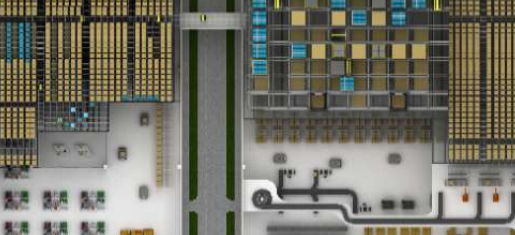
Centralized Multi-Warehouse Management
Goods and shuttle can be freely dispatched between different storage areas
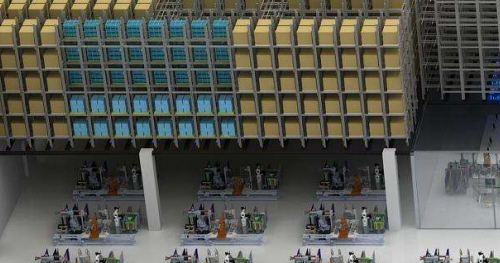
Up-Store, Down-Pick Operation
Supports bulk storage and individual item picking simultaneously
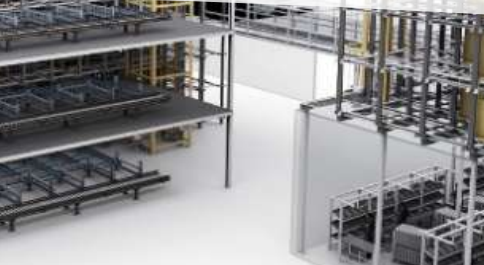
Maximize the use of warehouse status
Application advantages of small/irregular building area and on building floors
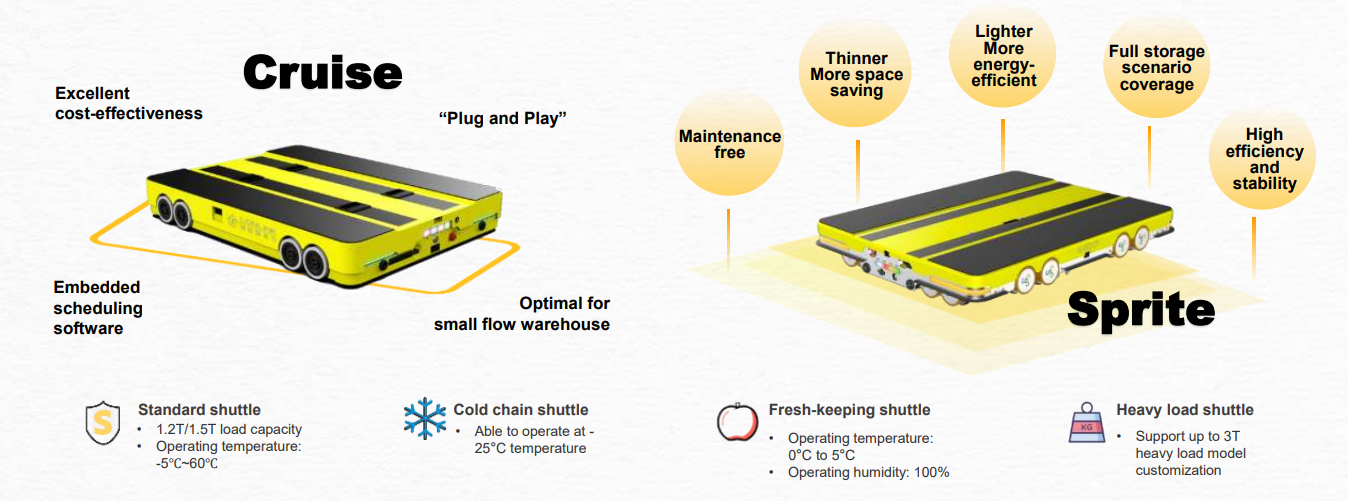
Specifications
| Cruise | Sprite | |
|---|---|---|
| Dimensions (L*W*H) | 1160 * 960 * 150mm | 1210 * 960 * 127mm |
| Dead weight | 350 kg | 270 kg |
| Loading capacity (Max.) | 1200 kg | 1500 k g |
| No-load speed (Max.) | 2.0 m/s | 2.0 m / s |
| Full-load speed (Max.) | 1.0 m/s | 1.0 m / s |
| Positioning Accuracy | ± 2 mm | ± 2 m m |
| Operating Time | ≥ 6 h | ≥ 7 h |
| Charging Time | ≤ 1.5 h | ≤ 1.5 h |
| Charging Method | Charging station / Auto charging | Charging station / Auto charging |
| Battery | 48V / 40Ah, LiFePO4 | 48 V / 42Ah, LiFePO4 |
| Wheels | 12 | 16 |
| Operating temperature | -5℃~60℃ | -30℃ model customizable |